The flag of the United States is one of the
oldest national standards in the world. No records confirm who designed
the original "Stars and Stripes," but historians believe Francis
Hopkinson, one of the signers of the Declaration of Independence,
probably modified the unofficial Continental flag into the design we now
have. General George Washington raised the Continental Army flag in 1776,
a red-and-white striped flag which included the British Union Jack where
we now have stars.
Several flag designs with 13 stripes were used in 1776 and 1777, until
Congress established the official flag on June 14, 1777 — now observed as
Flag Day. The act stated "That the Flag of the thirteen United States be
thirteen stripes, alternate red and white, that the union be thirteen
stars, white in a blue field, representing a new constellation." George
Washington explained it this way: "We take the stars from heaven, the red
from our mother country, separating it by white stripes, thus showing
that we have separated from her, and the white stripes shall go down to
posterity representing liberty."
The flag was first carried in battle at Brandywine, Pa., in September
1777. It first flew over foreign territory in early 1778, at Nassau,
Bahama Islands, where Americans captured a fort from the British.
Betsy Ross Sews First Official Flag
Hopkinson requested compensation from Congress in 1780 for his design,
but Congress denied it, saying that others had worked on the project as
well. Betsy Ross was commissioned by a congressional committee to sew the
first official flag. Some believe she was responsible for changing the
stars from being six-pointed to five-pointed, easier to make.
After Vermont and Kentucky became states in the 1790s, Congress
approved adding two more stars and two more stripes to the group that
represented the original 13 colonies, now states. This was the "Star
Spangled Banner" of which Francis Scott Key wrote in 1814. As other
states entered the Union, it became obvious that stripes could not be
added continually, so in 1818 Congress reestablished the 13-stripe flag
and allowed for additional stars for new states.
1818 Law Sets Final Form
The law specified that stripes should be horizontal, alternately red
and white, and the union, or canton, should display 20 stars for the
states then in the union. But it did not specify color shades or
arrangement of the stars, and wide variation persisted. During the Civil
War, gold stars were more common than white and the stars sometimes
appeared in a circle. In 1912, when the stars numbered 48, standards of
design were set which became even more precise when the 49th and 50th
stars were added in 1959 and 1960.
The regulated design calls for seven red and six white stripes, with
the red stripes at top and bottom. The union of navy blue fills the upper
left quarter from the top to the lower edge of the fourth red stripe. The
stars have one point up and are in nine horizontal rows. The odd-numbered
rows have six stars. The even-numbered rows have five stars, centered
diagonally between the stars in the longer rows.
The reason the flag is folded into a triangular shape is to symbolize
the shape of the cocked hats worn by soldiers of the American Revolution.
The first time the Stars and Stripes flew in a Flag Day celebration
was in Hartford, Conn., in 1861, the first summer of the Civil War.
Numerous patriotic groups supported a regular nationwide observance. In
the late 1800s, schools held Flag Day programs to contribute to the
Americanization of immigrant children, and the observance caught on with
individual communities. But it was not until 1916 that the president
proclaimed a nationwide observance and not until 1949 that Congress voted
for Flag Day to be a permanent holiday. It is not a "legal" holiday,
however, except in Pennsylvania.
Flag Named Old Glory
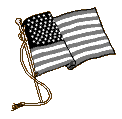
The name "Old Glory" was first applied to the United States Flag by a
young sea captain who lived in Salem, Massachusetts. On his twenty-first
birthday, March 17, 1824, Captain William Driver was presented a
beautiful flag by his mother and a group of Salem girls. Driver was
delighted with the gift. He exclaimed, "I will name her 'Old Glory.'"
Then "Old Glory" accompanied the captain on his many voyages.
Captain Driver quit the sea in 1837. He settled in Nashville,
Tennessee. On patriotic days he displayed Old Glory proudly from a rope
extending from his house to a tree across the street. After Tennessee
seceded from the Union in 1861, Captain Driver hid Old Glory. He sewed
the Flag inside a comforter. When the Union soldiers entered Nashville on
February 25, 1862, Driver removed Old Glory from its hiding place. He
carried the Flag to the Capitol building and raised it above the state
capitol.
Shortly before his death, the old sea captain placed a small bundle
into the arms of his daughter. He said to her: "Mary Jane, this is my
ship's Flag, 'Old Glory.' It has been my constant companion. I love it as
a mother loves her child. Cherish it as I have cherished it."
The flag remained as a precious heirloom in the Driver family until
1922. It was then sent to the Smithsonian Institution in Washington, DC,
where it can be seen today.

Guidelines For Display Of The U.S. Flag
Public Law 94-344, known as the Federal Flag Code, contains rules for
handling and displaying the U.S. Flag. While the federal code contains no
penalties for misusing the flag, states have their own flag codes and may
impose penalties. Traditional guidelines call for displaying the flag in
public only from sunrise to sunset. However, the flag may be displayed at
all times if it's illuminated during darkness. The flag should not be
subject to weather damage, so it should not be displayed during rain,
snow and wind storms unless it is an all-weather flag.
It should be displayed often, but especially on national and state
holidays and special occasions.
The flag should be displayed on or near the main building of public
institutions, schools during school days, and polling places on election
days.
It should be hoisted briskly and lowered ceremoniously.
When carried in procession with other flags, the U.S. flag should be
either on the marching right (the flag's right) or to the front and
center of the flag line. When displayed on a float in a parade, the flag
should be hung from a staff or suspended so it falls free. It should not
be draped over a vehicle.
When displayed with another flag against a wall from crossed staffs,
the U.S. flag should be on its own right (left to a person facing the
wall) and its staff should be in front of the other flag's staff. In a
group of flags displayed from staffs, the U.S. flag should be at the
center and the highest point.
When flags of states, cities or organizations are flown on the same
staff, the U.S. flag must be at the top (except during church services
conducted at sea by Navy chaplains).
When other flags are flown from adjacent staffs, the U.S. flag should
be hoisted first and lowered last. It must be on the right of other flags
and no other flag should stand higher than it. Flags of other nations
should be flown from separate staffs. International custom dictates that
flags of different nations be displayed at the same height in peacetime
and be approximately the same size. If the flag is suspended outdoors
from a rope stretched from a building to a pole, the flag should be
hoisted out from the building with the union first. When the flag is
displayed other than from a staff, it should be flat or suspended so that
it falls free.
When displayed against something, such as a wall, the union should be
at the top and to the flag's own right, the observer's left - whether
displayed horizontally or vertically.
When displayed over a street or sidewalk, where it can be seen from
either side, be sure the union is to the north on an east-west street,
and to the east on a north-south street. The same directions apply in a
building lobby or corridor with entrances to the east and west or north
and south.
When displayed flat against the wall on a speaker's platform, the flag
should be above and behind the speaker with the union on the left side as
the audience looks at it (again, the flag's right).
When the flag hangs from a staff in a church or public place, it
should appear to the audience on the left, the speaker's right. Any other
flags displayed should be placed on the opposite side of the speaker.
The flag may cover a casket, but should not cover a statue or monument
for unveiling. It should never be draped or drawn back in folds. Draped
red, white and blue bunting should be used for decoration, with the blue
at the top and red at the bottom. On a casket, the union (blue field)
should be at the deceased person's head and heart, over the left
shoulder. But the flag should be removed before the casket is lowered
into the grave and should never touch the ground.
The flag may be flown at half-staff to honor a newly deceased federal
or state government official by order of the president or the governor,
respectively.
On Memorial Day, the flag should be displayed at half-staff until
noon. Whenever the flag is displayed at half-staff, it should be first
raised to the top. Lowering from half-staff is preceded by first raising
it momentarily to the top. |

 The
United States Flag
The
United States Flag
 Our
Culture
Our
Culture